Home›Knowledge Center›Riyadh

Real Estate Market Report — Riyadh Region 2026
Real Estate Market Reports · 2026 Edition

Real Estate Market Report — Riyadh Region 2026

Strategic analysis and market dynamics for 2026

This report by Takamol Advanced offers a strategic analysis of Riyadh's real estate market dynamics for 2026, covering offices, housing, retail, hospitality, regulation, transaction volumes and non-Saudi ownership zones. Its scope spans Riyadh city and its suburbs (Khuzam, Al-Fursan, Qiddiya and Diriyah), drawing on first-half 2026 data from official sources including the Real Estate Registry, the Ministry of Justice and the Real Estate General Authority.

PDF · 64 pages · 18.4 MB

Key figures

8.6M+

Residents in Riyadh's population base

540+

Global companies with regional HQs in Riyadh

65%+

Riyadh's share of Saudi inbound FDI

18–28K

Estimated annual housing gap, in units

98%

Grade A office occupancy

SAR 50.5B

Registered deal value over the last six months

What the report covers

A summary of each theme. The full detail, charts and tables are in the report.

01

Executive Summary and Key Performance Indicators

Macro indicators point to a market running close to full capacity: a population of over 8.6 million, 63.8% of them under 35, more than 540 global companies with regional headquarters in Riyadh, and over 65% of Saudi Arabia's inbound FDI. Annual housing need is estimated at 45–55 thousand units against roughly 27 thousand delivered, an estimated annual gap of 18–28 thousand units. The section also maps risk against return for each sector and sets out a roadmap of milestones through the 2034 World Cup.
02

Office and Administrative Space Sector

Grade A offices are 98% occupied versus 86–88% for Grade B, with more than 5.1 million m² of existing office space and annual Grade A rent growth of 12% to 15%. KAFD leads rental growth at 18.5%, with rents of SAR 2,800–3,600 per m² a year. With net annual absorption of 350,000–400,000 m², rental pressure is set to persist until at least 2028, and the report expects rents to rise 7% to 10% a year as supply begins to balance slightly.

03

Residential Sector and Housing Market

Riyadh's existing housing stock exceeds 1.45 million units, 54% of them apartments, and more than 68% of young Saudi families prefer apartments in fully serviced communities. Average apartment prices rose 8.5% to SAR 5,400–6,300 per m² and apartment rents 11.2%, with net yields of 6.4%–7.2%, reaching 8.5% for small units in serviced complexes. Some 80,500 units are expected to be delivered over 2026–2028, while the market needs 45,000–55,000 new units a year.

04

Retail and Shopping Centres

Existing leasable retail space exceeds 4.7 million m², with net yields of 8.2%–9.0%, vacancy of just 2.1% in super-regional malls and 97.9% occupancy at major destinations. Open-air centres outperform with 96.5% occupancy against 90.3% for regional enclosed malls, and food, beverage and entertainment account for 48% of daily footfall. The section maps the major project pipeline, including The Avenues Riyadh at over 390,000 m² in 2027, and rents by corridor ranging from SAR 1,200 to 4,200 per m².

05

Hospitality and Hotels

The market has 24,800 hotel keys at 74.5% annual occupancy, rising to 94%–98% during major conferences and Riyadh Season, with an average daily rate of SAR 865 and RevPAR growth of 19.5%. Business and MICE travel accounts for 60% of demand. Serviced apartments show the highest expected IRR at 15.5%–18.5%, while the report rates post-2030 hotel oversupply as a high-impact risk and proposes ways to hedge against it.

06

Legislative and Regulatory Framework

The non-Saudi ownership law took effect in January 2026, with a disposal fee of up to 5% of the property value on sale and fines of up to SAR 10 million. White land fees are levied at 2.5% of market value a year; more than 65 million m² in Riyadh have been invoiced and over 22 million m² have entered development. The section also covers the Ejar network, which cut rental disputes by 82%, the 2.5% brokerage commission cap, real estate registration, and REITs with assets above SAR 35 billion.

07

Real Estate Transaction Volumes

Over the last six months Riyadh recorded 25,325 deals in the Real Estate Registry worth about SAR 50.5 billion. Residential leads by count with 19,711 deals (78%) worth SAR 28.3 billion, averaging SAR 1.44 million per deal and SAR 4,485 per m². Mixed-use deals lift total value with SAR 14.1 billion (28%), while vacant land deals average SAR 17.37 million each, signalling a shift by developers and investors toward larger, longer-horizon projects.

08

Non-Saudi Ownership Zones in Riyadh

The report identifies eight approved zones for non-Saudi ownership around Riyadh's giga-projects: King Salman International Airport, New Murabba (19 km²), Qiddiya, Diriyah Gate (14 km²), the Sports Boulevard, King Abdullah Financial District (1.6 million m² of buildings), King Salman Park (over 16 km²) and the Sedra project (ROSHN). It maps each zone's boundaries in detail, alongside an overview map of all approved ownership areas in the city.

09

External Benchmarks and Takamol Platforms

This section sets the report's estimates against indicators from international and official sources for 2025–2026, including a projected Riyadh population of 9.6 million by 2030, prime office rents of SAR 3,320 per m², and 200 million Riyadh Metro trips through March 2026, noting that methodologies differ. It closes with Takamol's three platforms: GeoForsa for geospatial intelligence, RealInvest for automated feasibility studies, and RealForsa for curated investment opportunities.

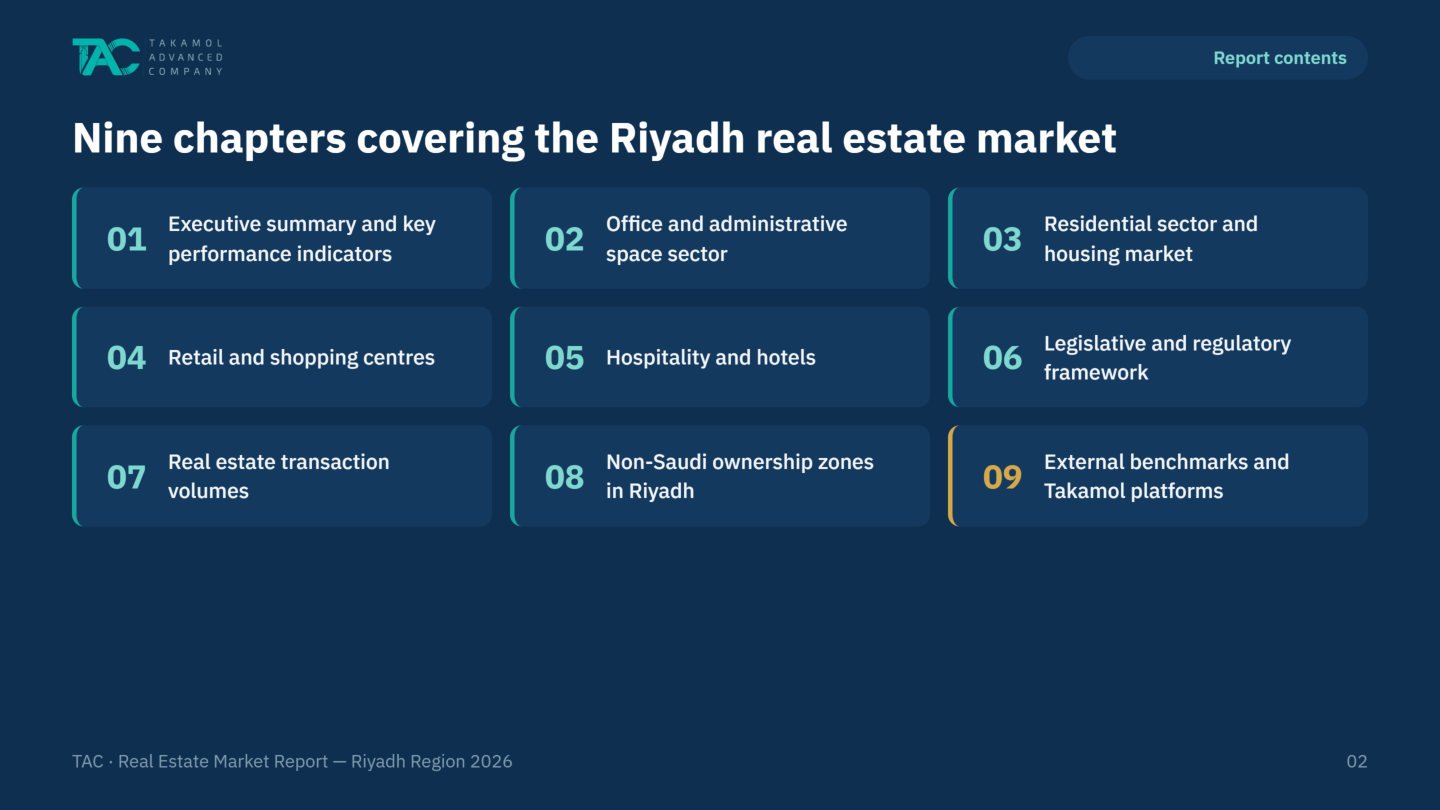
The report's contents page

Get the full report

The full report includes the detailed analysis, charts, data tables and their sources, along with the investment opportunity maps.

Download the PDF reportPDF · 64 pages · 18.4 MB

This summary is drawn from Takamol Advanced's 2026 real-estate market reports, and its figures are for general information. See the full report for detail and sources.

More reports